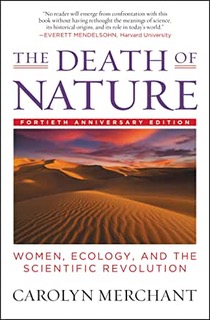
 The
Death of Nature; Women, Ecology, and the Scientific Revolution by Carolyn Merchant (3rd edition, 2020)
The
Death of Nature; Women, Ecology, and the Scientific Revolution by Carolyn Merchant (3rd edition, 2020)
How the scientific revolution sanctioned the exploitation of nature, commercial expansion, and the subjugation of women.
Translations: Japanese, Chinese, Korean, Italian, French, German, Swedish, Spanish, Argentinian Spanish, Brazilian Portuguese.
"Women and nature have an age-old association--an affiliation that has persisted throughout culture, language, and history. Their ancient interconnections have been dramatized by the simultaneity of two recent social movements--women's liberation, symbolized in its controversial infancy by Betty Friedan's Feminine Mystique (1963), and the ecology movement, which built up during the 1960s and finally captured national attention on Earth Day, 1970. Common to both is an egalitarian perspective." (From the Preface)
- "No reader will emerge from confrontation with this book without having rethought the meanings of science, its historical origins, and its role in today's world." -Everett Mendelsohn, Harvard University
- "Brilliantly conceived and richly researched." -Susan
Griffin, author of Woman and Nature
- "Enormously disquieting. . . similar to . . . reading Silent Spring. As Carson's (1962) book revealed the invisible (toxins), The Death of Nature brought the concealed into the domain of consciousness."- Max Oelschlaeger, University of Northern Arizona, Flagstaff
- "What is the influence of The Death of Nature? It
is, simply, enormous! [It is] unprecedented [in] the ways in which the
feminization of nature and the naturalization of women are linked historically."
-Karen Warren, Macalester College
- "As many readers as one asks, one is bound to hear as many celebrations." "The first [book] to provide a sustained analysis of the sexual politics embedded in the language . . . of modern science." -Robyn Eckersley, Monash University, Melbourne
- "Without question, The Death of Nature: Women, Ecology, and the Scientific Revolution is one of the most successful and influential books of feminist scholarship ever written. . . . The book's continued ability powerfully to connect sexism and other forms of domination prevalent in modern life with an historical and analytic framework for examining ecological devastation remains deeply compelling." -Charis Thompson, in Routledge Handbook of Gender and Environment
 Autonomous Nature: Problems of Prediction and Control From Ancient Times to the Scientific Revolution by Carolyn Merchant (2016)
Autonomous Nature depicts the history of nature as rebellious, recalcitrant, rambunctious, and unruly. It asks how people from ancient times through the Scientific Revolution of the seventeenth century thought about nature and sought to predict and control it through science and experimentation. Yet despite the dramatic achievement of Western science, the limits of nature's predictability are still manifested today in the effects of natural disasters, extreme weather, and climate change.
The cover image depicts Mt. Vesuvius volcano erupting over Pompeii, Italy in 79 C.E. Roman naturalist Pliny the Elder died in the blast and the event was recorded by his nephew Pliny the Younger. Image from the documentary, "Pompeii, the Last Day," used by permission of the BBC.
- "In this ambitious history of ideas, Carolyn Merchant calls attention to the ancient idea of nature as unpredictable, rebellious, and impossible to understand and control completely. She urges us to recover that older idea for the foundation of a new ecological ethic. Wide ranging, original, and provocative." -Donald Worster, author of Nature's Economy: A History of Ecological Ideas
- "Merchant has written a key history of ideas for evaluating two of the big questions for today: how did we get into this mess and how do we get out of it. Western thinkers, who gave us the scientific method, also fell short of the truer, fuller view of reality, dynamical and chaotic. It is against this richer backdrop that we can grasp today's emerging complexity paradigm, and find hope and insight for restoring our planet's beautifully 'rambunctious gardens.'" -Jennifer
Wells, California Institute of Integral Studies, author of Complexity and Sustainability
- "This is another brilliant book by Carolyn Merchant who has been an inspiration to many of us in the environmental and feminist movements for so many years. Autonomous Nature takes the reader on a fascinating journey through European intellectual history, from antiquity to the twenty-first century, following the image of nature as orderly but also chaotic and unpredictable--a view that is fully consistent with the emerging systemic conception of life." -Fritjof Capra, coauthor of The Systems View of Life: A Unifying Vision
- "This is another brilliant book by Carolyn Merchant who has been an inspiration to many of us in the environmental and feminist movements for so many years. Autonomous Nature takes the reader on a fascinating journey through European intellectual history, from antiquity to the twenty-first century, following the image of nature as orderly but also chaotic and unpredictable--a view that is fully consistent with the emerging systemic conception of life." -Fritjof Capra, coauthor of The Systems View of Life: A Unifying Vision
 Spare the Birds! George Bird Grinnell and the First Audubon Society by Carolyn Merchant (2016)
In 1887, a year after founding the Audubon Society, explorer and conservationist George Bird Grinnell launched Audubon Magazine. The magazine constituted one of the first efforts to preserve bird species decimated by the women's hat trade, hunting, and loss of habitat. Within two years, however, for practical reasons, Grinnell dissolved both the magazine and the society. Remarkably, Grinnell's mission was soon revived by women and men who believed in it, and the work continues today.
In this, the only comprehensive history of the first Audubon Society (1886-1889), Carolyn Merchant presents the exceptional story of George Bird Grinnell and his writings and legacy. The book features Grinnell's biographies of ornithologists John James Audubon and Alexander Wilson and his editorials and descriptions of Audubon's bird paintings. This primary documentation combined with Carolyn Merchant's insightful analysis casts new light on Grinnell, the origins of the first Audubon Society, and the conservation of avifauna.
- "Carolyn Merchant's Spare the Birds! George Bird Grinnell and the First Audubon Society is environmental history at its finest. Merchant makes the indisputable case that Grinnell should be forever honored a a top-tier conservation hero. Highly recommended." -Douglas Brinkely, author of Rightful Heritage: Franklin D. Roosevelt and the Land of America
- "Merchant has provided a splendid guide to the lives of the men and women who began the work of saving America's wildlife legacy. Every bird lover should want to own it." -Donald Worster, author of A Passion for Nature: The Life of John Muir
- "Carolyn Merchant restores women and gender roles to the standard 'boys' club history of early American conservation--and tops it off by compiling Grinnell's wonderful writings on birds and on John James Audubon. A gift to birders and historians alike."-Jenny Price, author of Flight Maps: Adventures with Nature in Modern America
- "George Bird Grinnell could not himself have chosen more wisely than Carolyn Merchant for his interlocutor. This work is not merely a significant contribution to our understanding of the man and his times but imperative reading as we contemplate measures for the conservation of birds in the years to come."
-Shepard Krech III, author of Spirits of the Air and The Ecological Indian
- "Spare the Birds! tells a unique story that was only vaguely known before. A major contribution." -John F. Reiger, author of American Sportsmen and the Origins of Conservation and The Passing of the Great West: Selected Papers of George Bird Grinnell
 Reinventing Eden: The Fate of Nature in Western Culture by Carolyn Merchant, 2nd ed. 2013. (Also available in a Kindle Edition)
Reinventing Eden traces the Garden of Eden myth from the Mesopotamian regions where agriculture--and the creation myth--first began, through the Greek and Roman empires, the Enlightenment, and the modern capitalist world. Time and again, human manipulation of the environment is our downfall: Eden is achieved by fencing off pristine beauty in national parks and wildlife preserves, while leaving the majority of the Earth in ruins.
- This new edition of a classic work shows a formidable knowledge of western philosophy and science. Merchant is a world-renown historian working at the top of her form." -Donald Worster, author of Nature’s Economy and A Passion for Nature: The Life of John Muir
- Merchant takes readers on a wondrous intellectual journey through the philosophizing and mythologizing that has created Western understandings and expectations of nature, as well as how women and men view and relate to each other. The scope of the Eden myth is breathtaking in its implications, and one wonders what other story could be as powerful." -Paula DiPerna, Women’s Review of Books
- "Reinventing Eden is fascinating, extensively researched, and historically comprehensive. Merchant’s vision for a partnership ethic, in which nature and humanity are equal, healthy, and mutually responsive partners in ecologically sound and just relationships, is brilliant. This book is a must-read for anyone interested in philosophically sound, ethically just, and ecologically sustainable solutions to the current environmental crisis." -Karen Warren, editor of Ecofeminism, Culture, and Nature
- "Merchant uses the distant and near past to explore the changing conception of nature in Western society’s future . . . with a depth of personal commitment and fervor that--particularly when the product is that of such an accomplished and respected scholar--makes Reinventing Eden a must-read for students of nature in American culture." -Brian Black, American Studies
- "No one has plumbed the philosophical and historical grounding of nature--the nature of nature--with greater acuity than Carolyn Merchant. To set a course for partnerships that must evolve between humankind and the rest of nature--for sustainability--Reinventing Eden is the essential guide." -Shepard Krech III, author of The Ecological Indian
- "Merchant constructs a ‘partnership ethic’ to bring humans and nature together in joint decision making about sustainable environments. . . . [She] draws from the broad streams of Western culture to envision this partnership between humans and nature in holistic interconnection." -Rosemary Radford Ruether, Claremont School of Theology
- Merchant takes readers on a wondrous intellectual journey through the philosophizing and mythologizing that has created Western understandings and expectations of nature, as well as how women and men view and relate to each other. The scope of the Eden myth is breathtaking in its implications, and one wonders what other story could be as powerful." -Paula DiPerna, Women’s Review of Books
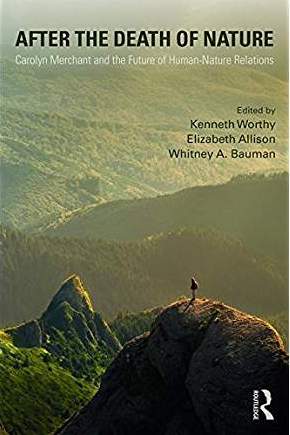 After the Death of Nature: Carolyn Merchant and the Future of Human-Nature Relations. Edited by Kenneth Worthy, Elizabeth Allison, and Whitney A. Bauman. New York: Routledge, 2019.
Carolyn Merchant's foundational 1980 book The Death of Nature: Women, Ecology, and the Scientific Revolution established her as a pioneering researcher of human-nature relations. Her subsequent groundbreaking writing in a dozen books and over one hundred peer-reviewed articles have only fortified her position as one of the most influential scholars of the environment. This book examines and builds upon her decades-long legacy of innovative environmental thought and her critical responses to modern mechanistic and patriarchal conceptions of nature and women as well as her systematic taxonomies of environmental thought and action. Seventeen scholars and activists assess, praise, criticize, and extend Merchant's work to arrive at a better and more complete understanding of the human place in nature today and the potential for healthier and more just relations with nature and among people in the future. Their contributions offer personal observations of Merchant's influence on the teaching, research, and careers of other environmentalists.
"This book reaffirms Carolyn Merchant as the foundational guru of modern environmental history and ecofeminism. The fine essays in After the Death of Nature, ably edited by three outstanding scholars of ecology, offer irrefutable testimony to the timeless importance of Merchant as a writer, philosopher, and public educator. It's impossible to properly think about the natural world without grappling with Merchant's far-reaching 21st century global vision." -Douglas Brinkley is the Katherine Tsanoff Brown Chair of Humanities and Professor of History at Rice University. He is author of Rightful Heritage: Franklin D. Roosevelt and the Land of America, among other books, and is a CNN Contributor.
- "This collection of essays is one of the finest anthologies of its kind. It brings together stellar scholars to celebrate Carolyn Merchant's life work. What more fitting tribute to her accomplishments than these excellent essays, which should be widely read in the years to come." -Mary Evelyn Tucker, Yale Forum on Religion and Ecology and co-author of Journey of the Universe.
 Science and Nature: Past, Present, and Future by Carolyn Merchant, 2018.
Science and Nature brings together the work and insights of historian Carolyn Merchant on the history of science, environmental history, and ethics. The book explores her ideas about the interconnections among science, women, nature, and history as they have emerged over her academic lifetime. Focusing on topics such as "The Death of Nature," the Scientific Revolution, women in the history of science and environment, and partnership ethics, it synthesizes her writings and sets out a vision for the twenty-first century. Anyone interested in the interactions between science and nature in the past, present, and future will want to read this book.
- "The product of a rich life of intellect and activism, this book is a must read for anyone concerned with nature, gender, and the future of life on our planet." -Londa Schiebinger, author of The Mind has No Sex?; Nature's Body; and Has Feminism Changed Science?
- "Carolyn Merchant has been one of the true pioneers of environmental history, making important contributions for more than four decades. This collection will enable readers to sample and savor the wide-ranging nature of her work over the full sweep of her career." -William Cronon, Author of Changes in the Land and Nature's Metropolis
- "Science and Nature is a wide-ranging feast of scholarship from early modern mechanics, natural philosophy, and sociology of knowledge to eco-feminism and environmental history...Carolyn Merchant's trenchant critique of the grand narrative of the Scientific Revolution is prerequisite to her critical analysis of contemporary environmental justice and her offering of a new and visionary ethic of partnership with Nature." -Francesca Rochberg, author of Before Nature and The Heavenly Writing
- "Dating from the early seventies to the present, this collection of lively essays, artfully revised to create a coherent whole, demonstrates Carolyn Merchant's lucid mastery and synthesis of the full spectrum of the environmental humanities...This dramatic engagement of an often hubristic Science with obdurate Nature is critically examined through the moral lens of feminism and environmental ethics." -J. Baird Callicott, Author of In Defense of the Land Ethic and Thinking Like a Planet.
 American Environmental History: An Introduction. by Carolyn Merchant, (New York: Columbia University Press, 2007) Second edition of The Columbia Guide to American Environmental History.
American Environmental History addresses contentious issues such as the preservation of the wilderness, the expulsion of native peoples from national parks, and population growth, and considers the formative forces of gender, race, and class. Entries address a range of topics, from the impact of rice cultivation, slavery, and the growth of the automobile suburb to the effects of the Russian sea otter trade, Columbia River salmon fisheries, the environmental justice movement, and globalization.
- "Merchant takes a most useful approach to environmental scholarship by encapsulating a daunting range of factual information and critical information into this practical volume. . . . one of the best books of its kind." History
- "An impressive introduction to environmental history. . . . Merchant has succeeded in producing an accessible first step handbook that will be relied on for many years." Environmental Practice
- "Merchant has been one of the most important scholars building the field of environmental history. Her excellent guide will be of use to new students in environmental history and to established scholars coming into the field from other areas." John H. Perkins, The Quarterly Review of Biology
- "Merchant provides a valuable introduction to the topics and perspectives that characterize the discipline." - Arn M. Keeling, Department of History and Philosophy, Montana State University, H-HistGeog
 Ecological Revolutions : Nature, Gender, and Science in New England by Carolyn Merchant, 2nd ed. 2010.
With the arrival of European explorers and settlers during the seventeenth century, Native American ways of life and the environment itself underwent radical alterations as human relationships to the land and ways of thinking about nature all changed. This colonial ecological revolution held sway until the nineteenth century, when New England's industrial production brought on a capitalist revolution that again remade the ecology, economy, and conceptions of nature in the region. In Ecological Revolutions, Carolyn Merchant analyzes these two major transformations in the New England environment between 1600 and 1860.
In a preface to the second edition, Merchant introduces new ideas about narrating environmental change based on gender and the dialectics of transformation, while the revised epilogue situates New England in the context of twenty-first-century globalization and climate change. Merchant argues that past ways of relating to the land could become an inspiration for renewing resources and achieving sustainability in the future.
- "A highly readable, landmark book." -Earth Ethics
- "An impressive, strong, and extraordinarily well documented case for the adoption of an ecocentric relationship to the environment." -Agriculture and Human Values
- "Ecological Revolutions is thoroughly recommended to those who want to clarify their own visioning of the present via a re-visioning of the past." -Annals of the Association of American Geographers
 Earthcare
: Women and the Environment by Carolyn Merchant, 1996.
Earthcare
: Women and the Environment by Carolyn Merchant, 1996.
Written by one of the leading thinkers in environmentalism, Earthcare is an inspiring collection of work on feminism and the environment. In her latest innovative contribution to this lively field, Carolyn Merchant looks at age-old historical associations of women with nature, beginning with Eve and continuing to environmental activists of today. She also discusses women's commitment to environmental conservation, and the problematic assumptions of women as caregivers and men as the dominators of nature.
Earthcare challenges humanity to revise the ways the Western world has produced, reproduced, and conceptualized its past relations with nature, and suggests a new partnership ethic of environmentalism which men and women alike can embrace. This book will appeal to all those who wish to move toward a cooperative approach to creating a habitable, sustainable world.
- "Carolyn Merchant . . . is a leading ecofeminist thinker. . . . She challenges humankind to rethink the way the Western world has conceptualized its relationship with nature." -Environmental Law
- "Written by one of the most brilliant thinkers in environmentalism, Earthcare is a rich collection of essays on feminism and the environment." -Ethics and the Environment
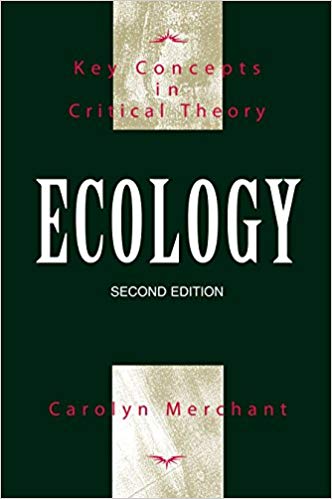 Ecology
(Key Concepts in Critical Theory) by Carolyn Merchant (Editor), 2nd Edition, 2008.
Ecology
(Key Concepts in Critical Theory) by Carolyn Merchant (Editor), 2nd Edition, 2008.
Essays by David Bohm, Herman Daly, Fritof Capra, James Lovelock, Vandana Shiva, Winona LaDuke, Ilya Prigogine, and others.
As we survey the effects of modernism-environmental destruction, the net consumption of irreplaceable natural resources, the ever-widening gulf between first and third worlds-we are forced to grapple with the consequences of the domination of nature with human beings.
The second edition retains many of the most provocative selections from the first edition, while the new, updated pieces explore contemporary matters in ecology and environmental philosophy; the disastrous consequences of globalization; the contradictions between indigenous peoples and conservation organizations; the path of ecofeminism from its roots to its current stance on gender issues and the environment; and an engaging look at the history of environmental movement and their controversies.
- "Congratulations. You have done a marvelous job! Your broad concept of critical theory is helpful." -Arne Naess, Founder of Deep Ecology.
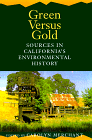 Green
Versus Gold : Sources in California's Environmental History by Carolyn Merchant (Editor), 1998. (softcover)
Green
Versus Gold : Sources in California's Environmental History by Carolyn Merchant (Editor), 1998. (softcover)
"Green Versus Gold" provides a compelling look at California's environmental history from its Native American past to conflicts and movements of recent decades. Carolyn Merchant has brought together primary sources and interpretive essays to create a comprehensive picture of the history of ecological and human interactions.
- "Lively new collection. . . . Shows how universal California's lessons are." -High Country News
- "A magnificent job in organizing primary materials. . . . An entertaining vade mecum for travelers, informative for students and policy makers." -Landscape Architecture.
- "A guide to the complex maze of California's environmental past and present. . . . Succeeds in its breadth and its accessibility." -Western Historical Quarterly
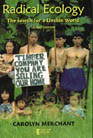 Radical
Ecology : The Search for a Livable World (Revolutionary Thought/Radical
Movements) by Carolyn Merchant, 2005, Second Edition.
Radical
Ecology : The Search for a Livable World (Revolutionary Thought/Radical
Movements) by Carolyn Merchant, 2005, Second Edition.
Radical Ecology responds to the profound awareness of environmental crisis which prevails in the closing decade of the twentieth century. In this provocative and readable study, Carolyn Merchant examines the major philosophical, ethical, scientific, and economic roots for environmental problems and examines the ways that radical ecologists can transform science and society in order to sustain life on this planet.
- "a lucid, lively, and well-balanced account . . . should be required reading for anyone interested in environmental issues. . . Useful to both novices and the knowledgeable--and practictioners as well." -Capitalism, Nature, Socialism
- "lucid, well documented, very readable. . . reflects a generosity of spirit." -Alternatives
 Major Problems in American Environmental History: Documents and Essays Edited by Carolyn Merchant, 2012. Third Edition.
Designed to encourage critical thinking about history, the Major Problems in American History Series introduces students to both primary sources and analytical essays on important topics in U.S. History. Each volume presents a carefully selected group of readings in an organization that asks students to evaluate primary sources, test the interpretations of distinguished historians and others, and draw their own conclusions.
The third edition retains many of the most popular documents and essays from earlier editions, while introducing new topics and new scholarship in this rapidly expanding field. New material is included on water, energy, urbanization, the automobile, environmental health, suburbanization, population growth, environmental justice, and globalization.
- "Extraordinary scope . . . variety [and] freshness in the selections. Teachers will find everything they need in a reader here. . . selection(s) from a well-known author, or something completely new." -Environmental History Review.
 Columbia
Guide to American Environmental History by Carolyn Merchant, 2002.
Columbia
Guide to American Environmental History by Carolyn Merchant, 2002.
How have Americans living at particular times and places used and transformed their environment? How have political systems dealt with conflicts over resources and conservation? The Columbia Guide to American Environmental History is the only major reference work to explore critical themes and debates within the burgeoning field of environmental history.
- "An indispensable tool for surveying one of the most
exciting and innovative new approaches to history that has emerged over
the past quarter century. We will be relying on it for years to come."
-William Cronon, University of Wisconsin
- "Carolyn Merchant has marshaled her formidable grasp
of American environmental history and her dedication to serving the
profession to produce a superb handbook that will make burgeoning developments
in the field readily accessible to a new generation of students, teachers,
and scholars." Susan Flader, Professor of History, University of Missouri-Columbia
- "Succinct yet comprehensive, this is a splendid introduction
to a vibrant new field of history, its key ideas, its fresh approaches
to the past, its impressive achievements." -Donald Worster, University
of Kansas
 Encyclopedia of World Environmental History, Vol. 1-3. Edited by Shepard Krech, III, J. R. McNeill, and Carolyn Merchant. A Berkshire Reference Book (New York: Routledge 2004)
This Encyclopedia offers a view of human interaction with the environment from the deep past to the present, encompassing the entire globe. It provides overviews of hundreds of topics, events, people, natural resources, and aspects of human culture and natural history. Includes sidebars, maps, and photographs.
• Packed with an incredible range of topics... The contributors and editors have done an admirable job in amassing a broad selection of topics in a succinct and readable tome. - Canadian Journal of Environmental Education
• This is the most ambitious effort yet to offer a comprehensive overview of the long-term history of human interactions with the natural world on a truly planetary scale. Contributors include some of the world's leading environmental historians and the Encyclopedia of World Environmental History should be a standard reference tool for years to come. - William Cronon, Frederick Jackson Turner Professor of History, Geography, and Environmental Studies, University of Wisconsin-Madison
 From Booklist:
Aimed at a broad audience of students, scholars, professionals, and general readers, this reference work contains 520 signed articles providing current, comprehensive coverage of environmental history from ancient times to the present. The well-written, alphabetically arranged articles range in length from one column to multiple pages.
Interdisciplinary and cross-cultural in approach, the encyclopedia covers a broad range of general topics, including arts, literature, biomes, climate, natural events, economic systems, energy, ancient civilizations, exploitation, philosophies, law, people, plants, animals, nonliving resources, places, religion, technology, and science. Examples of specific articles are Animal rights, Aristotle, Buddhism, Coffee, Danube River, Ecofeminism, Eden, Environmental ethics, Free trade, Germany, Global warming, Pleistocene overkill, Snail darter, Trans-Alaska pipeline, and Wilderness.
The text is augmented by 20 maps and more than 100 photographs. Some 115 sidebars provide engaging supplemental material, including extracts from historical documents, firsthand accounts, ethnographic accounts, environmental literature, poetry, and religious traditions. Suggestions for further reading accompany each article.
 The Anthropocene and the Humanities: From Climate Change to a New Age of Sustainability by Carolyn Merchant, 2020.
Translations: Russian, Turkish
This book focuses on the original concept of the Anthropocene first proposed by Eugene Stoermer and Paul Crutzen in their foundational 2000 paper. It undertakes a broad investigation into the ways in which science, technology, and the humanities can create a new and compelling awareness of human impacts on the environment. Using history, art, literature, religion, philosophy, ethics, and justice as focal points, the book traces key figures and developments in the humanities throughout the Anthropocene era and explores how these disciplines might influence sustainability in the next century. It argues for replacing the Age of the Anthropocene with a new Age of Sustainability.
• "A remarkably clear and accessible study of multiple dimensions of the environmental crisis and their effects on the humanities. -John R. Mc Neill, Author of The Great Acceleration: An Environmental History of the Anthropocene since 1945
• "A text of great importance that investigates how science, technology, and the humanities can create a new and compelling awareness of human impacts on the earth. -Mary Evelyn Tucker, Author of Journey of the Universe
• "Carolyn Merchant has written a pithy, well-rounded introduction to what the environmental humanities can offer in moving our planet toward a new Age of Sustainability." -Edward Melillo, Author of Strangers on Familiar Soil
• "Merchant emphasizes the need for engagement with the humanities if the human species is to find a way out of the Anthropocene and into what she calls "an Age of Sustainability." ... The idea is to showcase material that may throw light on the current ecological crisis and a possible exit from it, while recapitulating her previous writings on the themes." From: The American Historical Review, Volume 126, Issue 3, September 2021
 Hugo Iltis. Race, Genetics, and Science: Resisting Racism in the 1930s. ©David Iltis, compiled by Carolyn Merchant (2017)
This book is a collection of writings by Hugo Iltis, renowned biographer of the father of genetics Gregor Mendel (1924, English translation 1932). Writing in the 1930s, at the height of Nazi Germany's rise to power, Iltis used his extensive knowledge of Mendelian genetics to dismantle the "intellectual poison gas" being disseminated by Nazi theorists. His courage in standing up to the false science used to justify torture and death inflicted on people of Jewish ancestry caught the attention of none other than Albert Einstein. Einstein assisted in arranging Iltis's escape from Czechoslovakia just before the Nazi takeover in March 1939.
• Hugo Iltis was a courageous anti-racist academic and scholar whose pioneering work showed the fallacies in the Nazi's attempts to give racism a scientific foundation. Absorbing Iltis's insights should be an important element in educating an anti-racist movement that is desperately needed in Europe and the U.S in the 21st century. -Michael Lerner, editor of the Jewish and Interfaith Tikkun Magazine and author with Cornel West of Jews and Blacks - Let the Healing Begin
• The passion and rigor of Hugo Iltis's refutations of scientific racism during the Nazi era, which occupied a pivotal but internationally unrecognized place in the history of intellectual resistance to racism, establish important standards for antiracist research today. -Angela Davis, author of Freedom is a Constant Struggle: Ferguson, Palestine, and the Foundations of a Movement
• This is an important book. It brings to readers the life and writings of Hugo Iltis, and his courageous efforts scientifically debunking the genetic racism of Hitler and the Nazis. Not only are his writings fascinating history but they have critical validity in today's struggles against racism, ethnic cleansing, and xenophobia. -Ron Dellums, African American anti-Aparteid activist, politician